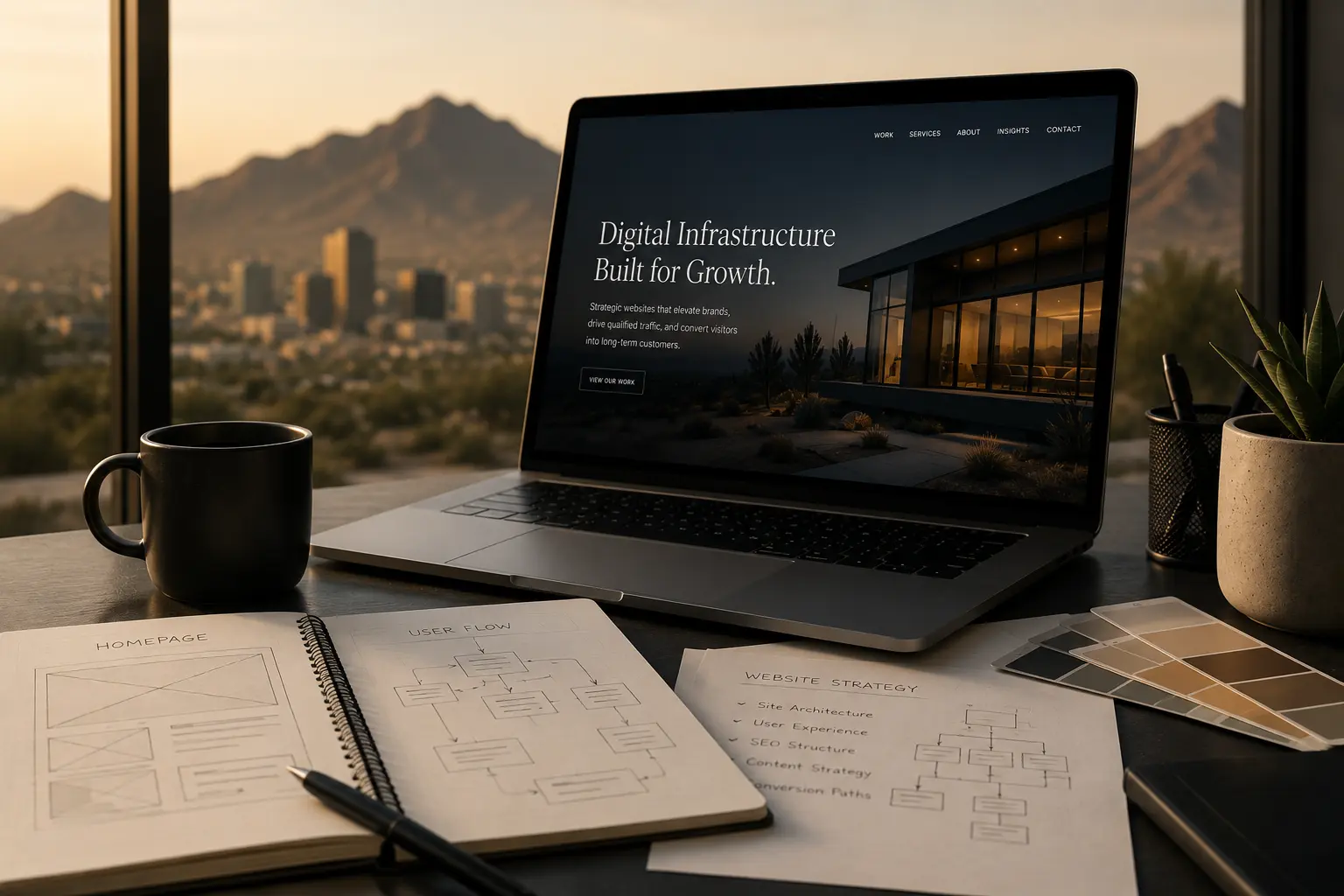



Many companies invest thousands—or even tens of thousands—of dollars into redesigning their websites with the expectation that new visuals will produce new business results.
The thinking seems logical:
Yet many organizations launch a beautiful new website only to discover that very little changes after the launch.
Traffic remains stagnant.
Lead generation stays inconsistent.
Sales conversations don't increase.
Months later, the redesign feels more like a cosmetic upgrade than a business investment.
The problem isn't usually the quality of the design.
The problem is that design alone rarely creates growth.
Growth comes from infrastructure.
Many businesses view a website as a marketing asset.
While this is partially true, modern websites have evolved far beyond simple marketing tools.
Today's website acts as the central operating system for a company's digital presence.
It influences:
When businesses focus exclusively on aesthetics during a redesign, they often ignore the systems that actually drive business outcomes.
A modern website should not simply look better.
It should function better.
A common mistake occurs when organizations begin redesign projects by discussing:
While these elements matter, they represent only a small portion of a successful website.
Without strategic planning, a redesign can result in a visually attractive website that performs exactly like the previous one.
The site may receive:
The website becomes a more attractive brochure—but not a more effective business tool.
The highest-performing websites are built on infrastructure.
Digital infrastructure refers to the systems that allow a website to scale, adapt, and remain effective over time.
This includes:
Visitors should be able to understand:
Clear architecture improves both user experience and search visibility.
Content should be organized around:
A structured content system allows businesses to continue growing their visibility long after launch.
Search visibility remains one of the most valuable long-term marketing channels available.
A website should be built with:
Without these systems, even exceptional content can struggle to gain visibility.
A growing percentage of users are discovering businesses through AI-driven tools.
Modern websites must help AI systems understand:
Companies that ignore AI discoverability may find themselves increasingly invisible in future search environments.
One of the largest misconceptions surrounding website projects is the belief that launch day represents the finish line.
In reality, launch day is the beginning.
The strongest websites continue to evolve through:
The businesses that see the greatest returns treat their websites as living systems rather than completed projects.
Forward-thinking organizations are moving away from viewing websites as isolated projects.
Instead, they are investing in digital infrastructure.
This approach recognizes that a website should support:
When these systems work together, a website becomes more than a digital brochure.
It becomes a growth platform.
Before beginning any website redesign, companies should ask:
These questions often reveal whether a project is focused on appearance or performance.
The most successful websites achieve both.
A beautiful website can create a strong first impression.
But impressions alone rarely generate sustainable growth.
The companies that achieve the greatest long-term results invest in digital infrastructure, strategic content systems, discoverability, and ongoing optimization.
When those elements are combined with exceptional design, a website becomes far more than a marketing asset.
It becomes a business asset capable of supporting growth for years to come.

Discover additional articles on brand identity systems, website architecture, SEO, and scalable creative execution for growing companies.